AI Is the Most Dangerous Technology Humanity Has Approached and Bill Gates Explains Why Regulation Can No Longer Wait
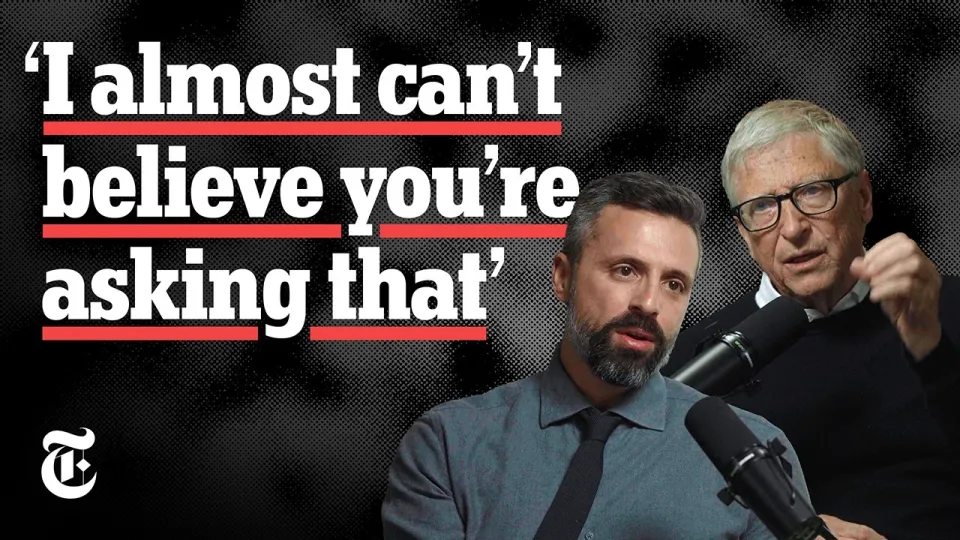
Video: Bill Gates: A.I. ‘Makes Nuclear Weapons Look Like Nothing’ | The Ezra Klein Show
Want articles like this for your own video to promote it on YouTube and Google? Order them through the Telegram bot @sat_sit_bot. Articles with your video embedded are written and posted by the bot itself — on popular topical sites (no ads). Try it free: 50 articles on us.
· based on the channel The Ezra Klein Show
AI is a technology more dangerous than nuclear weapons, and the window to govern it is closing faster than most governments realize. That is the core argument Bill Gates makes in a conversation with Ezra Klein, published by The New York Times Opinion section, where he says the AI industry cannot be trusted to police itself and that catastrophic cyber and biological attacks are a matter of when, not if. The full transcript of the discussion is available at the New York Times page for the episode.
What Bill Gates actually said about AI risk
Gates arrived at the interview with a position that inverted the usual framing: the alarmists, in his view, have not gone far enough. Klein noted afterward that he had rarely seen Gates so visibly agitated, and the transcript bears that out — Gates pushes back on questions, refuses to soften his language, and repeatedly returns to the same point, that people in positions of authority are in denial about what is coming.
The comparison he reaches for is nuclear weapons, and he uses it to argue the opposite of reassurance. Nuclear weapons are expensive, physically detectable and built by a handful of states with known facilities. AI is software. It can be copied, fine-tuned and deployed by almost anyone with a laptop and a credit card, and its capabilities can improve without a visible supply chain to inspect. That asymmetry is why Gates treats the nuclear analogy as a floor rather than a ceiling.
The two thresholds where AI stops being a productivity story
Gates separates AI risk into tiers, and only two of them matter for policy in the near term: cyber and bio. Everything below those thresholds — better coding assistants, faster drug discovery, cheaper customer service — is the story most companies are focused on. Above them, the failure mode is mass casualty.
- Cyber. Offensive security is one of the areas where model capability is already strong, because the same reasoning that finds vulnerabilities can find them at scale. Gates' concern is not a single dramatic hack but a shift in the economics of attack: what once required a skilled team becomes something a small group, or a single actor, can attempt repeatedly.
- Bio. The biological threshold is the one Gates treats as most consequential, and it connects directly to his decades of work on global health. The tools that make it easier to design a therapeutic also make it easier to design something harmful, and the gap between the two is narrowing as model capability grows.
His test for whether a risk is governable is blunt: if the worst case is measured in tens of millions of deaths, the response cannot be legal and retrospective.
Why self-regulation fails, in Gates' own framing
The line that landed hardest in the conversation is about lawsuits. Gates essentially argues that no serious person responds to a weapon of mass destruction by suing the manufacturer after the fact, and that treating AI companies as ordinary consumer-product vendors is a category error. The industry's own safety commitments, he suggests, are structurally incapable of holding when competitive pressure is real.
The reasoning is not complicated. A company that slows down to run more safety evaluations cedes capability and market share to a competitor that does not, and shareholders do not reward that. Voluntary commitments have no enforcement mechanism, no audit trail that outsiders can verify, and no consequence for withdrawal. Gates calls the belief that this arrangement is sufficient "insane" — a word he chooses deliberately, and one that explains why the interview reads less like a policy seminar and more like a warning.
The China race and the coordination problem
Gates does not treat AI safety as a purely domestic question, and the conversation spends real time on the US–China dynamic. The trap is symmetrical: if either side pauses unilaterally, it hands advantage to the other, so neither pauses. Gates' answer is not a unilateral moratorium but coordination on the specific things that are verifiable — model evaluations, incident reporting, and limits on the most dangerous capability categories.
There is a practical obstacle he acknowledges. Unlike warheads, AI models are not countable, and unlike reactors, they are not sited at known locations. Verification regimes designed for physical weapons do not transfer cleanly. That is the technical reason regulation lags, and it is also the reason Gates keeps returning to thresholds rather than to broad prohibitions: narrow, checkable rules are more likely to survive international negotiation than sweeping ones.
Jobs, inequality and the case for taxing AI labor
The economic half of the conversation is where Gates' foundation work meets his technology background. He describes a labor market that could bifurcate quickly, with a small number of people whose skills complement AI and a much larger group whose tasks are automated faster than retraining can absorb. The Gates Foundation has made AI-driven inequality a new priority, alongside a planned spend-down of roughly $200 billion over the next two decades.
The policy ideas he raises are more concrete than the usual calls for reskilling:
- Taxing AI labor. If machine output substitutes for human wages, the tax base that funds social insurance erodes with it. Gates has argued for taxing robots and AI labor before, and the logic reappears here.
- "Human reserved" jobs. Certain roles — care work, teaching, some public services — could be formally reserved for people, on the argument that the value is the human relationship rather than the output.
- A no-scarcity job market. Gates sketches a scenario in which AI lowers the cost of goods and services enough that the problem shifts from unemployment to distribution: who owns the productivity gains, and how they are shared.
- Developing nations. The conversation turns to economies that were counting on labor-intensive manufacturing as a growth path, and what happens if that path closes before they arrive.
He is careful not to claim certainty about the timeline, and Klein presses him on it. The disagreement between them is not about whether disruption happens but about how fast and how unevenly.
What viewers pushed back on
The reaction to the episode clustered around a few recurring doubts, and they are worth taking seriously rather than dismissing.
Is Gates overstating the danger? The most common counterargument is that incumbents always fear the next platform. But Gates is not a threatened incumbent here — he is a major funder of AI through his foundation and an early backer of frontier labs. His incentive runs the other way, which is part of why the interview is uncomfortable to watch.
Doesn't capitalism self-correct? The argument that market incentives will punish harmful products assumes customers can detect harm before it happens and can switch away. Neither holds for a cyber or bio incident, where the damage is irreversible and the victims are not the buyers.
Why not just regulate later, once the risks are clearer? Because the capability curve is steep and the regulatory timeline is slow. The gap between a model that can assist with biology and one that can meaningfully lower the barrier to harm is measured in generations of models, not decades.
What about education and children? Gates spends time on learning loss in rich countries and on what AI tutoring can and cannot fix, and he argues that rules for children's use of AI need to be set by regulators rather than by product teams optimizing for engagement.
Useful links
- Full transcript of the Bill Gates conversation on The Ezra Klein Show
- Book recommendations from guests of The Ezra Klein Show
Bottom line
Gates' argument is narrower than the headline suggests and harder to dismiss because of it: AI is not uniquely evil, but it is uniquely cheap to replicate, and the governance tools built for physical weapons and chemical plants do not fit software. His prescription is not a pause but enforceable thresholds, independent evaluation and a tax and labor policy that anticipates displacement rather than reacting to it. The discomfort in the interview comes from the mismatch he keeps pointing at — the people with authority to act are not treating this as urgent, and the people building it are not required to. The Ezra Klein Show is the forum where that gap gets examined at length, and the transcript is worth reading in full for the parts that do not fit in a summary.
If you want the primary source rather than secondhand coverage, start with the full episode transcript — it includes the exchanges on Epstein, foreign aid and education that this article only touches on.
Key takeaways
- Gates calls the idea that the AI industry can self-regulate "insane" and compares lawsuits to a response to a weapon of mass destruction.
- He identifies two hard thresholds — catastrophic cyberattacks and bio-terrorism — as the point where AI risk becomes existential.
- Gates frames AI as more dangerous than nuclear weapons because it is software: cheap to copy, hard to contain and impossible to inspect like a reactor.
- The Gates Foundation is set to spend down roughly $200 billion over two decades, with AI-driven inequality named as a new priority.
- Job disruption, a possible tax on AI labor and "human reserved" roles are on the table as policy responses.
Source: Bill Gates: A.I. ‘Makes Nuclear Weapons Look Like Nothing’ | The Ezra Klein Show · Markdown version
Questions & answers
Why does Bill Gates say AI is more dangerous than nuclear weapons?
Because AI is software. Nuclear weapons require rare materials, known facilities and state-level programs, which makes them detectable and countable. AI models can be copied, modified and deployed by small groups at low cost, and there is no inspection regime that maps onto them. Gates treats the nuclear comparison as a starting point for how seriously to take the risk, not as an exaggeration.
What does Gates mean when he calls AI self-regulation "insane"?
He means that voluntary industry commitments collapse under competitive pressure. A company that pauses for safety evaluations loses ground to one that does not, and there is no audit mechanism or penalty for walking away from a pledge. In his view, relying on companies to police themselves against catastrophic risk is a category error, comparable to handling a weapon of mass destruction through litigation after the fact.
Which risks does Gates single out as the near-term thresholds?
Cyber and bio. Offensive cyber capability scales unusually well with model reasoning, shifting attacks from skilled teams to small actors. Biological risk concerns the narrowing gap between tools that design therapeutics and tools that could design harm. Gates treats these two as the point where AI stops being a productivity story and becomes a security problem.
What job policies does Gates discuss?
He raises taxing AI labor as a way to protect the tax base when machine output substitutes for wages, and the idea of "human reserved" roles in care work, teaching and public services. He also describes a possible no-scarcity market where falling prices shift the problem from employment to distribution, and warns that developing economies counting on labor-intensive manufacturing may lose that path.